2007-05-02

Reading Travels with Charley (2007-05-02/07)

Montana has a spell on me. It is grandeur and warmth. If Montana had a seacoast, or if I could live away from the sea, I would instantly move there and petition for admission. Of all the states it is my favorite and my love.
--John Steinbeck, Travels with Charley in Search of America

"In... 1960, John Steinbeck and his poodle, Charley, embarked on a journey across America." Starting in New York he drove counter-clockwise around the United States in a three-quarter-ton pickup-truck with a camper top. Avoiding main thoroughfares he visited nearly forty states, with a stop in Seattle. Among other places, he visited the Badlands, Montana, California, Texas, New Orleans (witnessing an event in the history of desegregation), and then drove quickly through Virginia and back home to New York.

In 1962, my father, after reading Travels with Charley, went to graduate school in Montana. His future wife had refused to marry him until she finished her undergraduate degree, so he decided to study pharmacy in the meantime. In the middle of winter, he found the deep dark nights, white-out blizzard days, and forty below temperatures depressing. So he took a bus to Portland, Oregon, arriving with $50. He bought a newspaper and called a telephone number he saw in a classified advertisement. "Is that room for rent still available? If you pick me up at the bus station I'll rent it."

In 1995 I embarked on a journey across America. Starting in Portland, Oregon I drove clockwise around the United States in an orange 1976 Volkswagen Westfalia. Avoiding main thoroughfares I visited thirty-eight states, with a stop in New York. Among other places, I visited Montana, the Badlands, New Orleans (requiring repair for the Westfalia while leaving town), Texas, California, then drove quickly up the coast to my new home in Seattle.

In 2007, after reading Travels with Charley, I called my father to see if I remembered his story correctly. He was surprised at my memory of the detail. Both Travels with Charley and my father's own story were told to me in a memorable, conversational way.

2007-04-30

Reading The 8th Habit (2007-03-26/04-26)

Hopefully you're beginning to see how the 8th Habit--Find Your Voice and Inspire Others to Find Theirs--is another way of saying, "Use the empowering knowledge worker, whole-person model. Apply the 7 Habits (personal greatness), the 4 Roles of Leadership (leadership greatness) and the 6 principles or drivers to execution (organizational greatness) to that model."
--Stephen R. Covey, The 8th Habit: From Effectiveness to Greatness

"Why is the eighth habit longer than the first seven combined?" is a question I heard more than once while reading The 8th Habit. As the quote shows, The 8th Habit applies the seven habits to personal and interpersonal life in "Knowledge Worker Age," and then extends their paradigms into leadership and organizational greatness. Along the way Covey's writing references a confusing number of lists and research.

The 7 Habits of Highly Effective People proceeds from "private victory" to "public victory." Private victory is essentially making and keeping promises, implemented in the first three habits. Public victory is essentially involving others in the problem and working out the solution together, implemented in the next three habits. Habit 7 (Sharpen the Saw) "embodies all the other habits. It is the habit of continuous improvement...."

To elaborate on the habit of self-improvement for a healthy balanced life (an aim I mentioned in a previous book review), Covey identifies four dimensions: physical, mental, social/emotional, and spiritual. He identifies example activities for each dimension that build a person's productive capacity: exercise, nutrition, and stress management (for body); reading, visualizing, planning, and writing (for mind); service, empathy, synergy, and developing intrinsic security (for heart); and value clarification and commitment, and study and meditation (for spirit).

In Covey's First Things First these dimensions find expression in the subtitle: "To Live, To Love, To Learn, To Leave a Legacy." In The 8th Habit these four dimensions are the "whole person paradigm". The process of "finding your voice" involves answering questions along these dimensions: What drives your economic engine? What can you be the best in the world at? What are you deeply passionate about? What does your conscience counsel?

The entire eighth habit is "find your voice and inspire others to find theirs." Consequently the book proceeds from personal greatness to leadership greatness. From mental vision, physical (or economic) discipline, emotional passion, and spiritual conscience arise Covey's "4 Roles of Leadership": pathfinding, aligning, empowering, and modeling. These roles lead to these leadership activities:
  • Jointly determine the course.
  • Set up and manage systems to stay on course.
  • Focus talents on results, not methods, then get out of people's way and give help as requested.
  • Set a good example.
To the discussion of personal and leadership effectiveness, The 8th Habit adds survey results on organizational effectiveness. Covey's survey results suggest that organizations fail in "focus and execution," particularly these areas of execution: clarity, commitment, translation, enabling, synergy, and accountability. Organizational greatness comes from closing these execution gaps.

As its length suggests, there is more material in The 8th Habit than can be easily evaluated and applied after one reading. In fact, Covey suggests it as a yearlong personal growth and development program. Time will tell whether the eighth habit is as memorable as the seven habits were.

2007-04-23

Avoiding HFCS (2007-01/04)

Although my weight has dropped more than a pound per week in the last three months, I consider myself to be "eating healthy" and exercising rather than "on a diet." I have attempted to add foods to my diet rather than to avoid foods. I consume more fatty fish, walnuts, flaxseeds, green leafy vegetables, olive oil, fruits, and red wine. I also eat more often (albeit smaller meals).

However, there are a few large exceptions, ingredients I avoid in foods. These include caffeine after noon, trans fats ("there is no safe level"), and high fructose corn syrup (HFCS). Avoiding these requires reading nutritional labels--a surprising number of foods (especially breads) contain HFCS. When my avoidance of HFCS brings questions, I generally summarize by saying that it's an unnatural (highly processed) result of political pressure. This article explains more fully.

Rereading The 7 Habits of Highly Effective People (2007-03-24/04-21)

Suppose you were to come upon someone in the woods working feverishly to saw down a tree.
"What are you doing?" you ask.
"Can't you see?" comes the impatient reply. "I'm sawing down this tree."
"You look exhausted!" you exclaim. "How long have you been at it?"
"Over five hours," he returns, "and I'm beat! This is hard work."
"Well, why don't you take a break for a few minutes and sharpen that saw?" you inquire. "I'm sure it would go a lot faster."
"I don't have time to sharpen the saw," the man says emphatically. "I'm too busy sawing!"

--Stephen R. Covey, The 7 Habits of Highly Effective People

Last year a friend sent me an email message with this request: "I'm looking for advice on how to become a better contractor/consultant/professional. Any books you would recommend?" Early this year I told him in reply that if he read The 7 Habits of Highly Effective People I would re-read it and discuss it with him. As I've made reference in this blog to maturing beyond dependence, putting "first things first", and "sharpening the saw" both mentally and physically; it is appropriate to review this book and present its habits.

Book Review

A list of the seven habits is easy to find, so this review focuses on the underlying principles. (Indeed, being principle-centered rather than tribe- or work-centered is the most significant contrast I see between the writings of Covey and Immelman.) Consequently I have selected a half-dozen of the principles I have found corroborated in other reading and have attempted to practice in my pursuit of a balanced, effective life.
The Map is Not the Territory
The book 7 Habits begins with a discussion of paradigms or patterns of thought. Covey writes that paradigm "was originally a scientific term"; this is probably a reference to The Structure of Scientific Revolutions by Thomas Kuhn. Revolutionary changes occur in thought when paradigms shift.

A consequence of this concept is that when one's observations of the territory (reality) differ from the map one holds (one's patterns of thought), one has the opportunity to update the map. This is my pursuit of truth; I want to frequently update my mental maps to better anticipate consequences.
Mature from Dependence to Independence to Interdependence
The seven habits progress from dependence to independence to interdependence. Emotional, mental, physical, or spiritual dependence is a sign of immaturity in the respective area. However, independence is not complete maturity. Maturity is ultimately in relation to others, and consequently is interdependent. (I have often heard the pre/trans fallacy of conflating dependent and interdependent concepts.) In interdependent relating the whole is more than the sum of its parts. Nevertheless, independence precedes interdependence; dependent people are limited in their ability to constructively relate to others.
There is a Gap Between Stimulus and Response
The concepts of free will and responsibility are important to maturity. I endeavor to explain my actions based upon my values and my evaluation of the situation--not as a result of my environment. This is the meaning of "proactive."
Wisdom Anticipates Consequences
Realizing that one can choose a response to a stimulus is part of maturity; another part is realizing that one can not choose consequences. Consequences are a natural result of choices. This is the concept of cause and effect. Covey writes, "When we pick up one end of the stick, we pick up the other," but I don't think that aphorism conveys the idea well. "Whatever a man sows, this he will also reap," perhaps conveys it better. One of my personal measures of wisdom is the length of time considered when evaluating the consequences of one's actions.
Trust Requires Trustworthiness
One of the consequences to consider in choosing is trust. Jim comments that in Immelman's book trust results from an external event, a plot contrivance. Similarly contrived are trust exercises in which participants fall back into the waiting arms of other participants. These approaches assume low trust is more a result of suspicion than a result of untrustworthiness. The solution is then a technique rather than character.

In my experience, however, making and keeping promises is challenging. Breaking one's word depletes the "emotional bank account" of the relationship, in Covey's metaphor.
Good is the Enemy of Best
At work I sometimes say, "When everything is a priority, nothing is." It is better--after consulting the mental map and considering the long-term (particularly relational) consequences of one's choices--to prioritize what's important. Covey distinguishes between importance and urgency, dividing time into four quadrants depending on low or high urgency or importance. Quadrant II, important but not urgent, often has the highest-leverage activities. In Quadrant II are the "Sharpen the Saw" activities illustrated by the quote beginning this post.

The 7 Habits, particularly First Things First, then suggest scheduling one's priorities. If space is limited, put in the rocks, then the pebbles, and finally the sand; doing the reverse uses more space. Similarly, since time is limited, find a time for the "big things" and let the "small things" fill the moments between.

The Seven Habits Paradigm

How does one act on these principles? The book suggests developing the following habits:
  1. Be Proactive
  2. Begin with the End in Mind
  3. Put First Things First
  4. Think Win/Win
  5. Seek First to Understand... Then to be Understood
  6. Synergize
  7. Sharpen the Saw
[Added anchors for subsequent posts.]

2007-04-08

Reading An Inconvenient Truth (2007-04-03/08)

In 1995/1997, when my graduate research on rainfall predictors for reservoir models required analysis of climate data, friends would frequently request my opinion on global warming. I would reply that there was too much natural variability for me to conclude there was a warming trend.

Global warming wasn't directly related to my research--and my research, as it happened, wasn't directly related to my life. Therefore I was recently interested to see the scientific consensus and new information in the decade since I encountered climate data. Like my friend who wanted footnotes to the nightly news, I wanted footnotes for the film An Inconvenient Truth. I wanted to check the scales of graphs shown in the film (Are they logarithmic?) and the sources for the quotations (Are they peer-reviewed?). Consequently I purchased the book.

The book presents status of the scientific consensus as it appears in the popular press in a style similar to Harper's Index:
  • Number of peer-reviewed articles dealing with "climate change" published in scientific journals during the previous 10 years: 928
  • Percentage of articles in doubt as to the cause of global warming: 0%
  • Articles in the popular press about global warming during the previous 14 years: 636
  • Percentage of articles in doubt as to the cause of global warming: 53%
Those who have read Thomas Kuhn's The Structure of Scientific Revolutions will be aware that there are sociological forces at work in scientific consensus. Nevertheless, I suggest we should act upon the best available information, and apply the precautionary principle when future consequences are severe. I also note that the graphs throughout the book suggest ongoing global warming in the decade since I paid attention to climate data.

Of course, there are debates in scientific circles on particular points that the book and film present only in the form of a summary conclusion. The aim of book and film appears to be to present the basic scientific facts in a visual and memorable fashion. The complexity of the relevant thermodynamics is hidden behind the full color and large type.

At the end of the book there is a call to action, particularly to reduce carbon emissions. One of the ways is to "get around on less." Driving less is already one of my 2007 goals, as I noted when writing about simplicity and time savings.

Another of my goals related to An Inconvenient Truth is to spend six days in forest or wilderness. Several of the autobiographical sketches interspersed throughout the book and film show Al Gore's very personal appreciation for the environment. This, and his motivation for public service, have increased my respect for Al Gore while reading this book.

2007-03-31

Reading Catch-22 (2007-03-16/28)

Joseph Heller's Catch-22 appears to illustrate the insanity of war. Many have warned about the perverse incentives war creates--Dwight D. Eisenhower's farewell address (with its warnings about the military-industrial complex) and M. Scott Peck's People of the Lie (with its analysis of the My Lai Massacre and comments on standing armies) come to my mind. Catch-22 illustrates it with mostly-humorous stories of contradiction.

I wish, however, that the fictional stories of wartime insanity hadn't totaled 453 pages in my paperback copy. I had been reading it since finishing Don't Let's Go to Dogs Tonight, and I became bored with the theme. The book club for which I read Invisible Man selected Catch-22 to "fulfill my hipster quotient." Unfortunately I finished Catch-22 in Colorado Springs and so missed the monthly meeting to discuss a book.

2007-03-30

In Colorado Springs (2007-03-26/30)

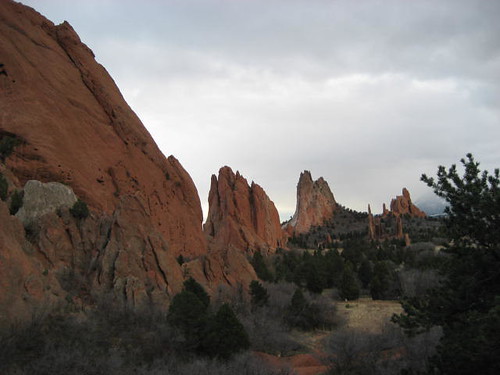
Garden of the Gods
As we drove past the "Garden of the Gods" exit sign on I-25 in Colorado Springs, CO, my business partner asked, "What's in Garden of the Gods?" "Rocks," I replied.

During March 26-29 we had travel days and three days of meetings with a client to improve our communication and teamwork, as well as address upcoming project milestones. On the last day of meetings one of our client's staff drove me through Garden of the Gods to see the rocks myself.

2007-03-25

At the IMA (2007-01-03/03-25)

As I sit in a University District cafe, my Remember the Milk list tells me that I've gone 35 times this year--roughly three times per week--to University of Washington's Intramural Activities Building. The $50 per quarter is a good investment! I want to maintain a healthy cholesterol and weight--and have a flat stomach--, so Ryan and I (and often friends) spend 20 to 30 minutes on the elliptical machines and then do some free weight lifting with our arms. Afterward I usually feel energetic.

On the Lower Route from Marangu to Kibo (2000-03-08/11)

Lower Route from Horombo to Kibo
After reviewing a book set in Africa, I began recording in this blog stories of my trip there, especially of my climb of Mount Kilimanjaro, and the people I met along the trail. Below is an outline of these events, from Marangu to Kibo.

I woke up at Marangu Hotel to a beautiful sunrise. After we packed and ate a large breakfast, the staff gave us a briefing and assigned us our guides and porters. I had a team of four:
  • my porter,
  • my guide,
  • my guide's porter, and
  • our cook.
We got into the truck—my guides and porters climbed in back while the driver showed me to the passenger side of the cab. Then we were off to Marangu Gate. From Marangu Gate we climbed over several days to Mandara and Horombo.

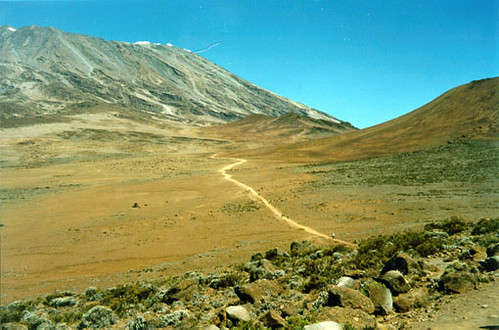
From Horombo Hut to Kibo Hut, the moorland vegetation gave way to alpine desert. Most people put on jackets.

From some points on the climb from Horombo Hut, I could see Kibo Hut at the base of Kibo as a tiny metallic sliver in the distance. My picture of Kibo from one rise includes for scale people on the trail ahead.

2007-03-22

At High Altitudes (2000-03-08/13)

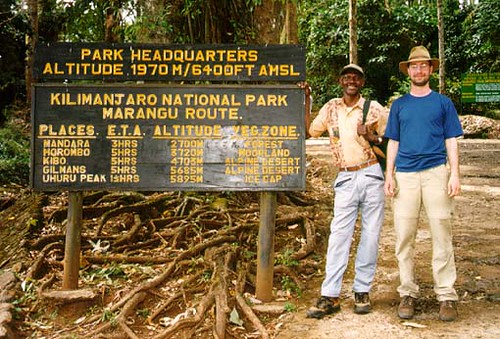
Marangu Route Altitudes
After reading a book with scenes in Africa, and another set in Africa, I decided to post memories and stories as well as photographs of my trip there. These are more stories of Kilimanjaro.

High altitude climbing is interesting. I have since decided (after climbing Mount Adams when I was out of shape) that I prefer streams and trees to rocks and snow. While the equatorial location of Mt. Kilimanjaro may make the temperature at higher elevations more like lower elevations elsewhere, I don't imagine there's any more oxygen.

A sign at Marangu Gate had some reference elevations. From Marangu Gate we climbed to our first stop, Mandara Hut. In regard to oxygen, I don't think anyone had too much difficulty at Marangu Gate (1 970 m, higher than Denver) or Mandara Hut (2 700 m), though the climb was tiring and the air noticeably thinner on the way.

Several people climbing Kilimanjaro at the same time I was—including two American doctors and some Austrian gentlemen—took Diamox to assist in acclimation. Ashley, a young woman who was part of a British couple climbing alongside me, starting taking it at Kibo Hut. Apparently it alters the oxygen dissociation curve so that hemoglobin will release oxygen more readily.

Additionally, many people—including me—stayed two days at Horombo Hut, taking an extra day to attempt to acclimatize. I'm told most people notice the effects of lack of oxygen due to altitude at around 3 000 m. Horombo Hut is at 3 720 m. After lunch there, we climbed up to the saddle between the two prominent volcanic peaks, Mawenzie and Kibo. On the way to the saddle, at 4 500 m, is Zebra rock.

While I was at Horombo Hut, one German young man was removed from Mt. Kilimanjaro in a stretcher, a victim of High Altitude Pulmonary Edema (HAPE), or fluid on the lungs. While some climbers asserted that they saw him alive at lower elevation, one American doctor also making the climb, who watched him pass in the stretcher, was convinced that he died before reaching the bottom. The Segmans, whom I met at Horombo Hut, corroborated this after returning to the park headquarters at Marangu Gate.

Apparently the young man had been sick at Horombo and Kibo Huts, and perhaps even at Mandara Hut. It may have been merely traveler's diarrhea, but dehydration might be deadly if one's body begins to retain water as in pulmonary edema.

While the climbers were abuzz with this news, I overheard one climber who reached Gilmans Point on the crater rim being asked if he had had any trouble. He said he had many symptoms: headache, dizziness, and hallucinations. I would not have persisted if I had experienced the latter, a symptom of High Altitude Cerebral Edema (HACE), or swelling of the brain.

They don't publicize the statistics, but my informal and anecdotal survey suggests that on the order of 1000's attempt Mt. Kili, 100's actually arrive at the crater rim, and 10's die. I heard that eight people died in December during the millennial climb. One woman died of HAPE on January 1, after she and her husband insisted on continuing to climb against their guide's recommendation.