2007-03-03

Reading Great Boss, Dead Boss (2007-02-23/03-03)

"'...[O]nce you understand tribal behavior, it seems to be just about the only workable model for successful social interaction.'"--Ray Immelman, Great Boss, Dead Boss

Book Review

Great Boss, Dead Boss is a book on leadership. In its pages it presents a theory of motivation as well as the management conclusions that this theory implies. It does all this within the context of a narrative. The plot illustrates the principles and the characters exemplify the leadership the book proposes.
Motivation Theory
The concept I had not encountered before I saw Great Boss, Dead Boss recommended is in Tribal Dimension 1: "Individuals are socially, emotionally, and psychologically defined by their tribal membership." (The second half of this long post contains a complete listing of Immelman's tribal attributes and dimensions.) This paradigm purports to explain motivation better than previous models. "[M]any MBA programs are less than optimal in this area," says Butch, who is the voice of the author in the narrative. Butch says, "Indeed, tribes appear to be the oldest organizational form and still exist in this modern day and age. I came to realize how deeply ingrained it was in human behavior through my experience with tribes in Africa."

Immelman applies this tribal model to what is essentially a simplification of Maslow's hierarchy of needs, that individuals seek security and value. Where Maslow proposed psychological, safety, and love/belonging needs, Immelman proposes individual security, "Individuals act to reinforce their security when under threat." Where Maslow proposed esteem, Immelman proposes individual value, "Individuals act to reinforce their self-worth when their security is not under threat." Other authors summarize these needs as "security and significance" or "relationship and impact."

Great Boss, Dead Boss extends the pursuit of security and value to the tribe as the determiner of individuals. Consequently the remaining two tribal dimensions mirror individual needs: "Tribes act to secure their self-preservation if their security is under threat," and "Tribes act to reinforce their self-worth when their security is not under threat." The replacement for the pyramid is a progression from low tribal security and low individual security to high tribal value and high individual value.
Management Practice
In addition to the tribal dimensions, Immelman's tribal attributes contain many good management ideas. A tribe must have a mission: "A strong tribe has a credible, just cause for its continued existence," and "A strong tribe has clear external measures of success." I infer from remarks in the book and in reviews that mission statements have been so commonly poorly developed that there is credibility in calling them something else ("just cause", "measures of success") and contrasting them with mission statements.

Other tribal attributes show the wisdom of sharpening the saw. "A strong tribe celebrates and cares for the skills, tools, and implements required for its prosperity." Greg, the protagonist of the narrative, even demonstrates a "Character Ethic," concluding, " A strong tribe has a leader dedicated to the tribe's success. "

Much of the book, however, could foster what Stephen Covey labels a "Personality Ethic." Greg sets about to apply tribal attributes as human relations techniques, saying, "I'm going to make our common enemy as tangible as possible," and "By introducing symbols, we actually create tribes." These are implementations of tribal attributes 1 and 2.

Greg cynically accepts individuals in a state of dependence: "I concluded that individuals prefer to subordinate their desires to that of the group, rather than take an individual stand." The methods of meeting esteem needs depend on others above or below: "A strong tribe has a revered figurehead," and "A strong tribe knows how it compares to the 'untouchables.'"
Book Narrative
The narrative itself conveys a pursuit of esteem through division between inside and outside, above and below. True to the principle that, "A strong tribe develops its own unique language," the protagonist uses abbreviations (IS, IV, TS, TV) that outsiders would not understand.

The main characters appear motivated by fame, glory, and respect. The story begins with displays of power, executives whose conversations look to me something like, "Go here, do this, do that, satisfy the board, see my secretary, I'm all upset about money." The book's alternative is a tribal guru, an African big-game hunter who mentors through terse answers, silences, and sudden ends to conversations. The book perhaps conveys to management readers that managing a successful company is somehow analogous in adventure to actually going to Africa.

Perhaps as a reflection of the patriarchy typical of tribes, no major character is female. The women (and children) take a supporting role, providing their men with time to pursue business objectives, and with food.

Personal Reaction
Frankly I don't fit the world in Great Boss, Dead Boss. I'm not a joiner. When I read, "A strong tribe expects unquestioning loyalty," I fear the True Believer. I feel belonging to small social connections rather than large social groups. I have responsibilities in my role as business owner, but I value this as one role in a balanced, effective life. For the future of my corporation, I'd rather see us develop a culture of interdependence, following on individual independence, based on character and competence. I'd like confidence based upon achievement independent of enemies, outsiders, and subordinates. Will being a tribal leader aid my company in achieving this aim?

Tribal Attributes and Dimensions

Tribal Attributes
Great Boss, Dead Boss lists twenty-three attributes of a very strong, highly motivated tribe and its leader:
  1. A strong tribe must have a common enemy.
  2. A strong tribe has clearly defined symbols.
  3. A strong tribe offers a superordinate identity to all sub-tribes.
  4. A strong tribe has a credible, just cause for its continued existence.
  5. A strong tribe has an accepted rite of passage.
  6. A strong tribe has clear external measures of success.
  7. A strong tribe understands and protects its source of power.
  8. A strong tribe knows how it compares to the "untouchables."
  9. The criteria for tribal membership are clear and credible.
  10. Tribes communicate in a non-traditional, subjective, and intuitive manner.
  11. A strong tribe develops its own unique language.
  12. Tribal roles are fundamentally different from accepted functional roles.
  13. Strong tribes record and celebrate significant events that reinforce their identity and value.
  14. A strong tribe has a clearly defined and well-known justice mechanism.
  15. A strong tribe has a clearly defined icon that embodies the tribal value.
  16. A strong tribe has a walled city--a place of refuge where things of value to the tribe are kept.
  17. A strong tribe possesses objects of value that embody the tribe's value.
  18. A strong tribe has a revered figurehead.
  19. A strong tribe celebrates and cares for the skills, tools, and implements required for its prosperity.
  20. A strong tribe expects unquestioning loyalty.
  21. A strong tribe has clearly defined roles, responsibilities, values, authority, power structure, and chain of command.
  22. A strong tribe has a leader dedicated to the tribe's success.
  23. Strong leaders have capable mentors whose psychological limits exceed their own.
Tribal Dimensions
The protagonist also examines five tribal dimensions:
  1. Individuals are socially, emotionally, and psychologically defined by their tribal membership.
  2. Individual Security (IS): Individuals act to reinforce their security when under threat.
  3. Individual Value (IV): Individuals act to reinforce their self-worth when their security is not under threat.
  4. Tribal Security (TS): Tribes act to secure their self-preservation if their security is under threat.
  5. Tribal Value (TV): Tribes act to reinforce their self-worth when their security is not under threat.
[Added anchor for subsequent post.]

2007-03-02

Considering Essential Art House: 50 Years of Janus Films (2007-03-01/04-22)

Films

What films shall I watch? In January I placed my online "Early Bird" order for Seattle International Film Festival (SIFF) 2007, but that doesn't start until May 24. In the meantime, March 1 through April 22, there is a series of art house films acquired by Janus Films.

I'd like to see some good films by famous directors. At least one film by Bergman, Fellini, Kurosawa, and Truffaut might be good. Below are my top picks for each (with links to the films showing for each director, and to the Internet Movie Database description of the films):
I'm asking film buffs for recommendations so I can schedule. Which films shall I see?

Details

If you would like to join me, the films show at the Nesholm Family Lecture Hall at Marion Oliver McCaw Hall, Seattle Center. (This hall was funded by Seattle in November, started in December, and completed in January.) There is a discount for SIFF members and students. For my top picks, below are the times that look good to me (with links to the schedule):

2007-02-26

Reading Invisible Man (2007-01-28/02-19)

"My belated appreciation of the crude joke that had kept me running, was not enough."--Ralph Ellison, Invisible Man

The narrator in Ralph Ellison's Invisible Man lives through a seemingly surreal sequence of events. The nightmarish quality of the plot may have been ordinary for a black man in the United States before Rosa Parks refused to relinquish her seat. (The book's copyright is 1947.)

Invisible Man illustrates the power of society to define reality, "running" its members without their awareness. This cynical thesis has no relief in the pages of the story, as the narrator finds no escape other than to hibernate. "A hibernation is a covert preparation for an overt action."

The book club for which I read Invisible Man has suggested Catch-22 for their next meeting March 26. In the meantime, I have several books to read to meet the goal of blogging 50 books this year, especially since I read Invisible Man slowly, alternating with other media.

2007-02-14

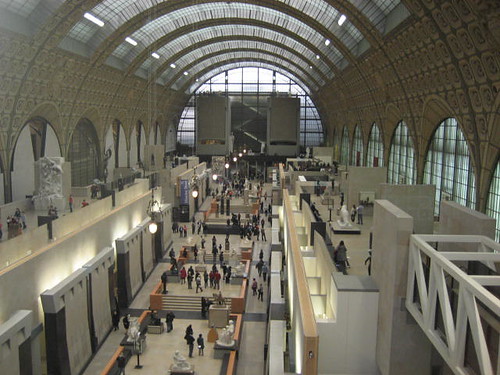
At Musée d'Orsay (2006-12-03)

Musée d'Orsay
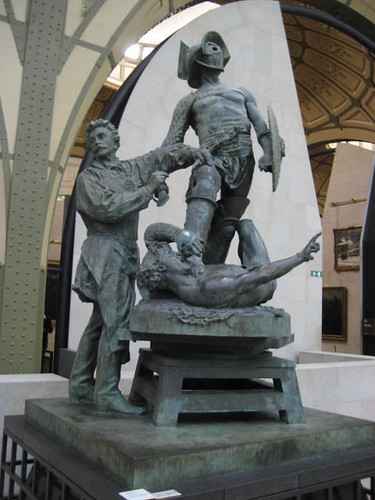
Sculpture of Sculptor Sculpting
Before I recommended Versailles, I wrote my friend that I'd recommend Musée d'Orsay. We went there our last day in Paris, and I'm glad we didn't miss it.

In Versailles (2006-11-08)

Back of Château de Versailles
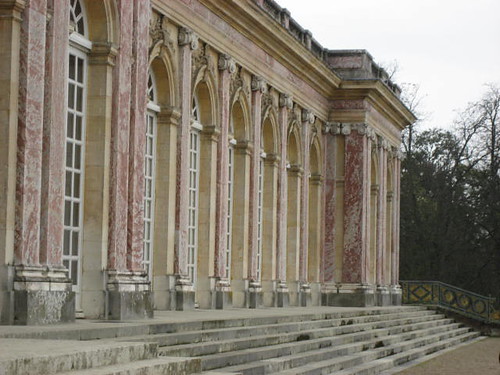
Back of Grand Trianon
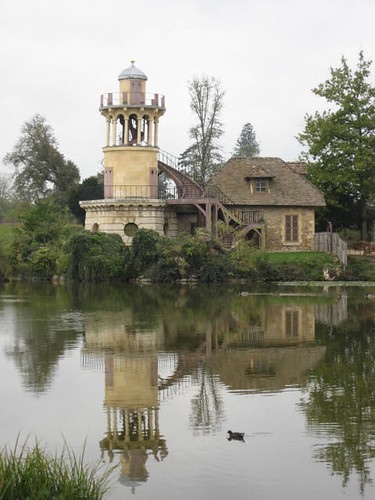
Petit hameau
A friend asked, "If you had three days in Paris and its environs, and had never been there before, what would you go see?" I recommended the places pictured in the photographs quite close to Paris on the map of my geotagged photos--in Paris and Chartres. (I excepted ones idiosyncratic to my visit like M. Berger's salon where I lived or Le Chao-Ba-Café where I worked remotely.) However, since my European travelogue then ended with October 23, 2006, at Château d'Amboise, I wrote that I'd recommend a Paris location from second half of my visit there. My recommendation is Versailles, so I've uploaded these to my Flickr photos. In Versailles we saw these places:
  • Château de Versailles (although La Galerie des Glaces was under renovation),
  • Château de Versailles park and garden (although the Fountain of Apollo had construction around it),
  • Grand Trianon,
  • Petit Trianon, and
  • Petit hameau.

Watching Das Leben der Anderen/The Lives of Others (2007-02-11)

Das Leben der Anderen/The Lives of Others contains both empathetic character development and entertaining plot twists. Set in East Germany before (and a little after) the fall of the Berlin Wall, the story follows the main characters, a Stasi officer and the playwright-and-actress couple he surveils, in a way that shows their humanity.

Director Florian Henckel von Donnersmarck said after a preview screening that the film has special meaning to many of those in Germany that viewed it or participated in its creation. In the cast one example is Sebastian Koch, who plays Georg Dreyman, the playwright: he experienced Stasi intimidation himself. In the crew another example is the property manager, who went to great lengths to assure the authenticity of the props in the film. In the audience many were reminded of their experiences in the GDR.

It sounded like Germany has some lack of constructive methods for its citizens to relate to former Stasi informants and officers, and to address the memory of the arrests, suicides, surveillance, and threats the film shows. Some Seattle audience members suggested the model of the Truth and Reconciliation Commission. I was reminded of Red Dust. However, the goal of the TRC was truth rather than justice. It's possible that since the Stasi files are available for review by those who were surveillance targets, the truth is sufficiently available.

Das Leben der Anderen is an engaging film due not only to the people, place, and time it portrays, but also for the suspenseful sequence of events. I recommend those near Seattle's Harvard Exit Theatre go see it when it opens there February 16.

At Café on the Ave (2007-02-14)

This popular cafe on University Way NE has WiFi (the key is on the receipt), many power outlets, cute baristas, good drinks, decent meals (the price buys generous helpings rather than gourmet food) and music (Washington band Death Cab for Cutie is playing now). Due to its proximity to UW students often occupy the four-person tables near the windows, but there are outlets elsewhere.

I "Sharpen the Saw" (as Stephen R. Covey writes) physically by getting my heart rate in the target zone three times a week--in addition to trying to eat healthy food. I use UW's IMA for this. Since other goals are to simplify my life by driving less and making transit time more tolerable, it makes sense to stay in the University District before or after my workout. Café on the Ave is a good place for me to work.

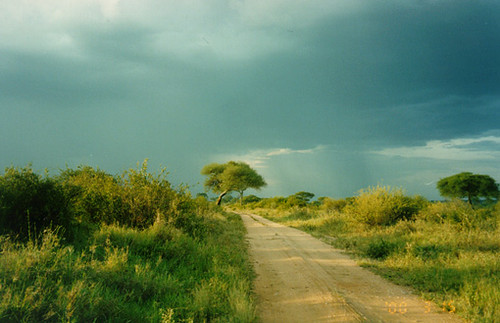
Wandering East Africa Years Ago (2000-03-01/31)

Indian Ocean Near Mombasa
Tarangire National Park
Sunrise from Hans Meyer Cave, Kilimanjaro

2007-02-08

Mulling over the truth of multitasking (2007-02-07)

"It’s not a Papal Edict, people; it’s 180 seconds of caffeinated ranting."--Merlin Mann, Responses to "43F Podcast: The Myth of Multi-tasking"

The summary for one of the podcasts I listened to from 43 Folders yesterday says this:
“Multi-taskers” are really just splitting their time and attention into smaller slices than you; no one can really do more than one thing at a time.
The "myth" of multitasking, Merlin says, is as credible as the yeti. He elaborates with exaggerated examples and the alleged expectation that we should be "parallel processing computers."

This caffeinated rant is confused from beginning to end. To "discover" that multitasking is "actually just... splitting... into very small slices" is to "discover" what is in computing the definition of multitasking. As the Wikipedia entry states, "The act of reassigning a CPU from one task to another one is called a context switch. When context switches occur frequently enough the illusion of parallelism is achieved."

Nevertheless true parallel processing--not simply the illusion of parallelism produced by multitasking--is also possible for humans. This morning I washed dishes while participating in a Skype standing meeting. My hands didn't stop rinsing dishes while I listened; I did two tasks simultaneously by any reasonable and useful definition.

Merlin's rant sounds as though its intent is to soothe the self-esteem of those who can't switch contexts easily. I disagree with the assertions and want to clarify the concepts. I find far more useful Steve Pavlina's "Do It Now" distinction between tasks requiring high attention and tasks requiring low attention:
The idea of multitasking may seem to contradict the previous piece of advice to work all the time you work. But whereas the previous tip refers to high intensity work where you must concentrate all your mental resources in order to do the best job you can, this tip addresses low intensity work where you have plenty of capacity to do other things at the same time, like standing in line, cooking dinner, flying on a plane, or walking from point A to point B. Multitasking shouldn't be used where it will significantly degrade your performance on a crucial task, but it should be intelligently used to take advantage of excess capacity.

Reading, and Listening to Podcasts

"Something was going on which I didn't get."--Ralph Ellison, Invisible Man

Ralph Ellison's Invisible Man

In the week and a half since my last blog post about a book, I've been reading Ralph Ellison's Invisible Man for a book club meeting February 19. I would probably not read this book if someone else hadn't selected it; it's not in my usual genres.

I find myself reading Invisible Man slowly because the narrator is frequently bewildered. If, in contrast, I understood the events he witnessed, this would be dramatic irony. Since I don't understand, either, it's simply confusing.

Savage Love Podcast

So sometimes I make transit time more tolerable by listening to podcasts instead of reading. I tried this several years ago with an MP3 player, and found the downloading and updating inconvenient. I tried again with a second-generation iPod nano, and the synchronizing is automatic, now that I use iTunes instead of WinAmp. I can listen in the car as well as on the bus, using a cassette tape adapter. On my iPod currently are .NET Rocks!, 43 Folders, AA Meeting: The Academy-Awards Related Obsessions of David Schmader (and Guests), and--because sex has always fascinated me--Dan Savage's explicit Savage Love sex advice podcasts. Several of these are Seattle locals.